
Agriculture & Food Security
OVERVIEW
Resilient food systems that thrive long after our programs end
For more than six decades, Partners of the Americas has worked alongside farmers, agribusinesses, and governments to build agricultural systems that feed families, create jobs, and connect rural communities to markets.
Our agriculture and food security projects strengthen value chains across crops and livestock, helping producers adopt improved practices and technologies that raise productivity and diversify income. We expand access to finance and markets through trade finance, co-investment, and partnerships with private sector buyers, and we work with government regulators to strengthen food safety systems and reduce barriers to trade.
Digital tools and hands-on technical assistance from local experts and U.S. volunteers help producers make better decisions and build skills that last.
The result is more stable incomes for farming families, growing agribusinesses, and stronger trade partnerships with the United States, leaving behind resilient food systems that continue to thrive long after our programs end.
Programs
Agriculture & Food Security
Increasing Productivity and Trade in Nigeria’s Aquaculture and Poultry Sectors
U.S. Department of Agriculture Food for Progress Nigeria · 2025–2029
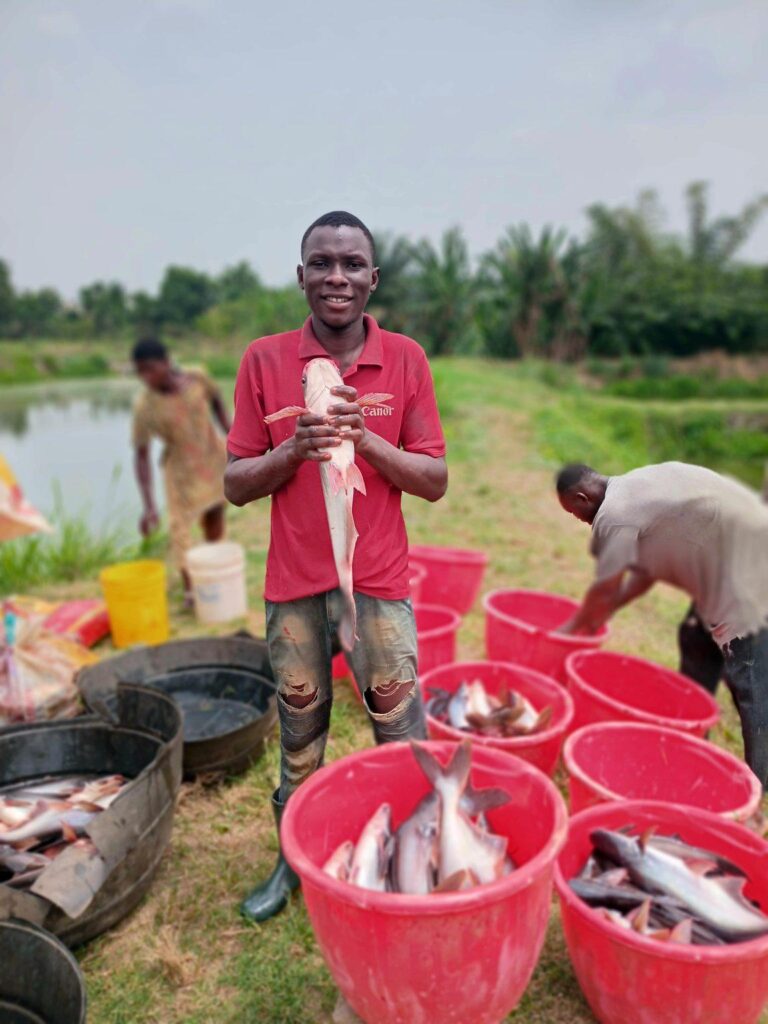
Demand for animal protein in Nigeria, a country of more than 230 million people, is outpacing what local poultry and fish farms can supply. To address this challenge, the U.S. Department of Agriculture is funding a project through its Food for Progress program. Implemented by Partners of the Americas, the project works with farmers, buyers, service providers, lenders, and regulators to improve the poultry and aquaculture market system. Partners of the Americas improves training systems, financial inclusion, and the adoption of innovative technologies. Food for Progress Nigeria additionally works to increase trade opportunities for U.S. agricultural technologies and inputs that improve aquaculture and poultry production. The project’s target regions are Lagos, Osun, Ogun, Edo, and Abuja.
The project is expected to increase productivity and incomes for 6,000 producers, increase access to finance, and create more jobs across poultry and aquaculture value chains. Partners of the Americas builds lasting capacity in local institutions at the market systems level so that interventions outlast the project.
Past Programs
Increasing Agricultural Productivity in Tunisia’s Oases
The two main goals of USDA Food for Progress Tunisia, implemented by Partners of the Americas, were increase trade between the U.S. and Tunisia and improve agricultural productivity in the oases sector. Tunisia is a key partner for the U.S. and supporting agriculture development efforts in the country are essential to maintaining robust economic and security partnerships. The project sought to enhance the sustainability of the oases crops in the southern regions of Tunisia by improving water management and building long term economic stability. Tunisia’s oases are a major agriculture production zone and the primary source of income and employment in the country’s southern regions.
The project was designed to catalyze the adoption of sustainable business models that reduce production costs, increase the farmgate price, and utilize economies of scale. In addition, the project will promote crop diversification to improve food security and provide additional revenue streams for producers. USDA Food for Progress Tunisia will operate by employing a cost-effective strategy that leverages innovations, incentives, and Tunisian private sector investments to achieve its objectives. Through these interventions the project was designed to improve the U.S.-Tunisia trade enabling environment by tackling food safety and trade facilitation, including the simplification, modernization, and harmonization of processes for the export, import, and transit of agricultural goods.
Sponsored by the United States Government
Increasing Horticulture Productivity and Food Security in Mauritania
Implemented by Partners of the Americas, the project had two main goals: to increase trade between the U.S. and Mauritania and improve horticulture sector productivity. These goals are related—Partners of the Americas harnesses U.S. technologies to increase Mauritanian farmers’ yields. Mauritania is a key U.S. ally, and supporting agriculture development efforts in the country is essential to maintaining robust economic and security partnerships. The project collaborates with the Mauritanian Government and has excellent relationships with federal, regional, and local authorities.
The project provided a sustainable, reliable source of fruits and vegetables to help meet Mauritania’s food security needs while increasing the resilience of farmers. Outcomes of the project were to increase two-way trade opportunities through trade fairs, two-way exchanges, market studies, and farmer demonstration plots. USDA’s investment in the Mauritanian agriculture sector boosts U.S. exports like machinery, cold storage equipment, seeds, crop protection products, and irrigation equipment exports. Partners of the Americas implements the project by employing a cost-effective strategy that leverages private sector investments to modernize and optimize Mauritania’s horticulture sector.
Sponsored by the United States Government
Increasing Cocoa Productivity and Food Security in Colombia
This project aimed to strengthen Colombia’s cocoa sector by supporting cacao farmers attain economically viable diversified farming systems, sustainable agricultural landscapes, and durable commercialization models. It strengthened Colombia’s cocoa sector to solidify U.S.-Colombia trade relations. The project represented USDA’s largest investment in Colombian agriculture, highlighting its strategic importance for both countries. The U.S. chocolate market, valued at $28.45 billion in 2025 and projected to reach $36.79 billion by 2030, depends on a stable cacao supply, as the U.S. does not grow cacao domestically. Colombia’s geographical proximity reduces transportation costs and enhances supply chain stability. C4D also strengthens the production of complementary crops for cacao, including plantain and Tabasco peppers, supporting domestic sales and U.S. exports.
Between 2022 and 2024, C4D engaged more than 5,000 producers, generating $14 million in cacao sales and strengthening 72 local producer organizations, improving their market access. To date, C4D has leveraged USDA’s investment to secure $2 million+ in cost-share commitments from local private and public sector partners. By providing training, technical assistance, and financial tools, C4D enhances Colombia’s economic resilience, mitigates migration pressures, and fosters regional stability.
Sponsored by the United States Government
Increasing Productivity and Trade in Nigeria’s Aquaculture and Poultry Sectors
Demand for animal protein in Nigeria, a country of more than 230 million people, is outpacing what local poultry and fish farms can supply. To address this challenge, the U.S. Department of Agriculture is funding a project through its Food for Progress program. Implemented by Partners of the Americas, the project works with farmers, buyers, service providers, lenders, and regulators to improve the poultry and aquaculture market system. Partners of the Americas improves training systems, financial inclusion, and the adoption of innovative technologies. Food for Progress Nigeria additionally works to increase trade opportunities for U.S. agricultural technologies and inputs that improve aquaculture and poultry production. The project’s target regions are Lagos, Osun, Ogun, Edo, and Abuja.
The project is expected to increase productivity and incomes for 6,000 producers, increase access to finance, and create more jobs across poultry and aquaculture value chains. Partners of the Americas builds lasting capacity in local institutions at the market systems level so that interventions outlast the project.
Sponsored by the United States Government